Travel guide
Halal Food in China: An Honest Guide for Muslim Travellers
Where to eat halal, city by city, and how to check without asking awkward questions
HalalFoodMuslim travel
Where to eat halal, city by city, and how to check without asking awkward questions
Chinese halal food is labelled 清真 (qingzhen) — literally pure and true. You will see it on restaurant signs, on packaged food, on butchers' shopfronts and increasingly on delivery apps. Green signage with the characters 清真 and often Arabic script alongside is the standard marker.
China has been home to Muslim communities for well over a thousand years. The Hui people, spread across every province, are the largest group, and their kitchens are the backbone of qingzhen food in the east. Uyghur food from Xinjiang is a distinct and excellent tradition, heavy on lamb, bread and hand-pulled noodles.
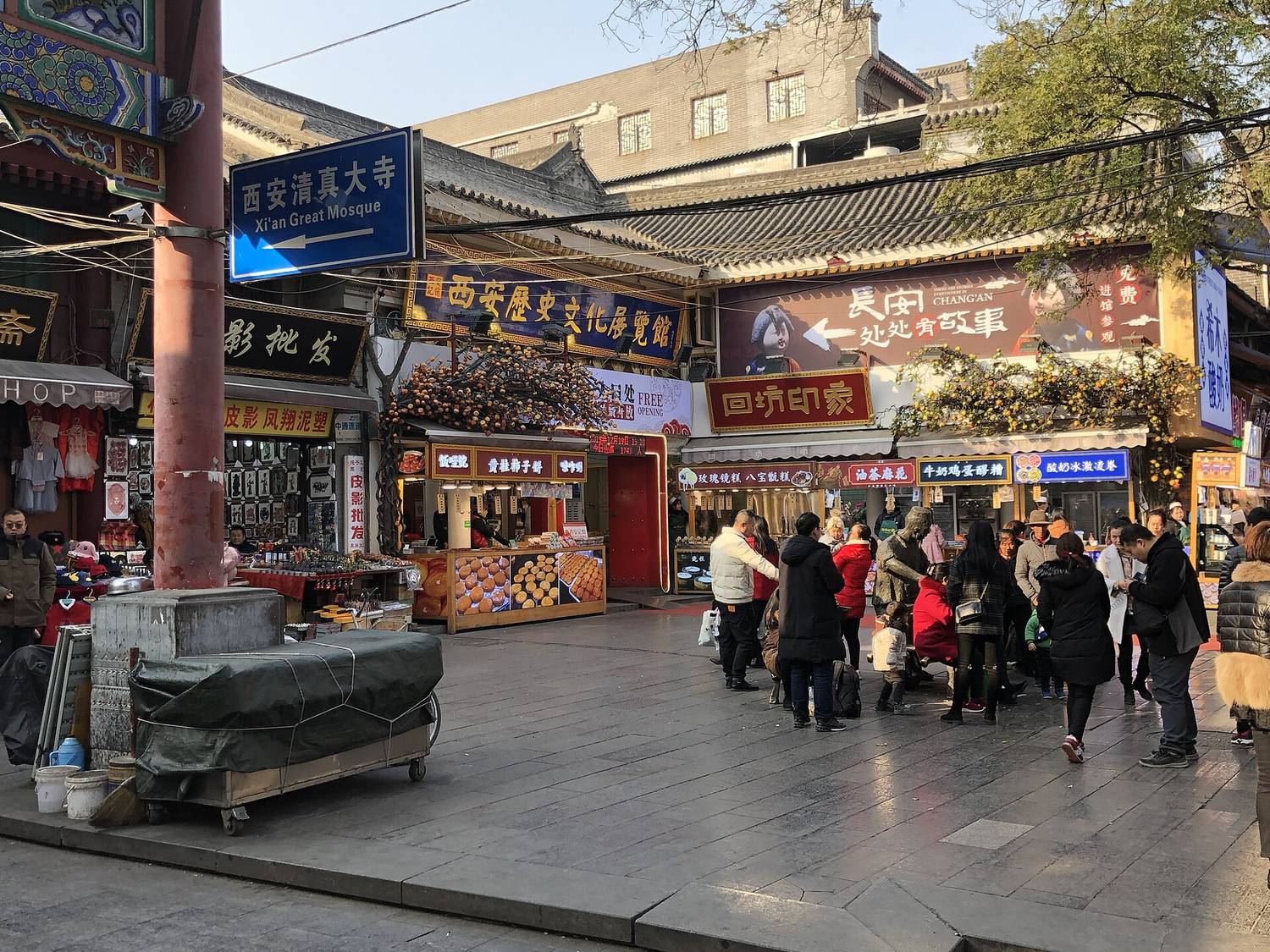
Xi'an is the best place in China for a Muslim traveller to eat. The Muslim Quarter around the Great Mosque is entirely qingzhen, the Hui community has been there for 1,300 years, and local cuisine is halal cuisine rather than a special-order version of it. You can walk the food streets and eat anything.
Guangzhou is second. A large, longstanding Muslim community, several historic mosques, and halal Cantonese restaurants where the entire dim sum menu is qingzhen. This is the only city where we can book a fully halal Cantonese banquet.
Beijing has the Niujie district south-west of the centre, active since 996 AD, with halal restaurants, butchers and bakeries on most blocks. Kunming, Lanzhou and Linxia in Gansu also have significant Hui populations and strong qingzhen scenes.
Zhangjiajie sits in Hunan, where the local cuisine is pork-heavy and famously spicy. There are halal-friendly restaurants in Zhangjiajie city, mostly Hui-run, but options inside the national park are thin — so on full park days we arrange a packed halal lunch with the hotel rather than take a chance on a snack stall.
Tibet is the hardest. Lhasa has a small Muslim community, a mosque near the Barkhor and a cluster of halal restaurants, but along the Lhasa to Shigatse road options are limited to a few towns. If halal-only dining is essential for your group, we will map exactly which meals we can guarantee and which need to be packed from Lhasa, and we will do that before you commit to the itinerary rather than after.
Guilin, Yangshuo, Shanghai, Hangzhou and Chengdu all sit in the middle: halal restaurants exist, we pre-confirm them, but they need booking rather than discovering.
Most three- to five-star Chinese hotels can prepare a Muslim-friendly or halal breakfast if asked in advance — usually egg dishes, steamed breads, congee and fruit, with halal-certified meat brought in or omitted. Ask at check-in and the answer is often no. Ask three weeks ahead through us and the answer is usually yes.
For every day of your itinerary we name the restaurant, confirm it is qingzhen, and note its location. Where a meal cannot be guaranteed halal, we say so in writing rather than leaving you to find out at the table.
A few reliable patterns. Buddhist vegetarian restaurants are always safe and China has excellent ones — the kitchen at Lingyin Temple in Hangzhou is a highlight. Seafood restaurants are straightforward. Yunnan and Guangxi cooking is vegetable- and mushroom-heavy and adapts easily. Sichuan food is spicy rather than pork-based, and halal Sichuan restaurants exist in Chengdu.
The general rule: in the big cities and in Xi'an, Guangzhou and the Hui regions, you eat without thinking. Elsewhere, you eat where we have booked, and we have usually booked better than you would have found.

Tell us your dates, who is travelling and roughly what you want to see. Within 24 hours a China-based planner sends you a day-by-day itinerary with everything itemised — free, and with nothing to pay until you approve it.
Monday–Sunday, 09:00–21:00 Beijing time (UTC+8)
Free written itinerary within 24 hours