The Best Time to Visit China: A Month-by-Month Guide
China is continental in scale, so the best month depends on where. Weather, crowds and holidays, month by month.
Read the article →
Pacing, stairs, toilets and medical care — and which sights genuinely work for older travellers.
Almost every family we plan for starts with the same worry: is China too hard for my parents? The honest answer is that the two things older travellers actually struggle with — language and logistics — are precisely the two things a private tour removes. You are never navigating a station in Chinese, never queueing for a taxi, never guessing what is on the menu. Add clean, safe, walkable cities, low street crime, heated hotels and a strong culture of everyday respect for older people, and China turns out to be a good destination for a multi-generational trip.
What does need care is pace, stairs, heat and medical planning. All four are manageable, and this article covers how.
The single most common mistake is copying an itinerary designed for a twenty-something traveller. A day that runs 8.30am to 8pm reads well on paper and collapses by day three. What works instead is one substantial sight in the morning, a proper sit-down lunch, a rest back at the hotel in the afternoon, and something light and close by in the evening.
Jet lag, heat and humidity all bite harder over 65, which is why April and October suit this kind of trip far better than July and August. A private car changes the arithmetic more than any other decision: the waiting happens in air conditioning, there is no walk to a metro station, and the day can end early without spoiling anyone else’s plan.
Worth knowing before you promise anything. The Forbidden City is a two to three kilometre walk on uneven stone with almost no shade; wheelchairs can be borrowed at the entrance. The Great Wall at Mutianyu has a cable car up and a toboggan or chairlift down, which turns a hard climb into a short walk along the ramparts — but the ramparts themselves still involve steep, uneven steps. The Terracotta Army pits are largely step-free with ramps and lifts, though the walk from the car park is long. A Yangtze cruise is the most accessible multi-day experience in China: you sleep on the boat, everything is on one level, and the shore excursions are optional.
Everywhere else the rule is the same. High-speed rail stations are vast, and the walk from the entrance to the platform alone can take ten minutes, so we book seats near the carriage door and allow extra time at both ends. Metro stations have long staircases and not every exit has a lift, which is another reason to travel by car.
We choose hotels for this kind of trip rather than for photographs. That means a lift, a walk-in shower instead of a bath with a high side, a room close to the lift and never on a high floor, a firm-but-soft mattress, and a Western breakfast so nobody has to start the day on unfamiliar food. In Beijing and Shanghai we often pick a hotel within walking distance of the main sight, so the day can be split around a rest.
On toilets, expect a mix of squat and seated. Malls, airports, hotels and high-speed trains have seated options, and the trains carry both types. Carry tissues and hand sanitiser, because paper is not always supplied. On the rails, first class is worth the modest supplement for older passengers: wider seats, more legroom and a quieter carriage. China Railway also runs a free assisted-travel service for passengers with reduced mobility, including a wheelchair, porter and station escort, which can be arranged through the 12306 app or at the station service desk a day ahead.
Bring more medication than you need, in original packaging, with a doctor’s letter listing drugs and doses — essential for anything controlled, or if you carry syringes. Pharmacies are everywhere, but their labels are in Chinese, so do not plan to replace a lost prescription locally. If anyone in the party has a pre-existing condition, declare it to your insurer: the cheap policies routinely exclude it, and the better ones let you buy that cover back.
Hospitals in Beijing, Shanghai and Guangzhou have international departments that accept foreign insurance and international cards, and we keep your nearest option on file for the trip. The bigger judgement call is altitude. Lhasa, Shangri-La and parts of Tibet and Sichuan start between 3,000 and 3,700 metres, and altitude is far less forgiving after 65. For most older travellers we either skip those stops or build a slow approach through Kunming and Dali first. If Lhasa is non-negotiable, a doctor’s sign-off and a deliberately light first two days are the minimum.
Chinese restaurant cooking is often oilier, saltier and spicier than visitors expect, and digestion becomes more sensitive with age. We brief every kitchen in advance on salt, chilli and oil, and we keep familiar dishes in rotation: steamed fish, congee, clear soups, noodles, steamed greens, dumplings. Halal, vegetarian and low-sugar requirements go into the same brief.
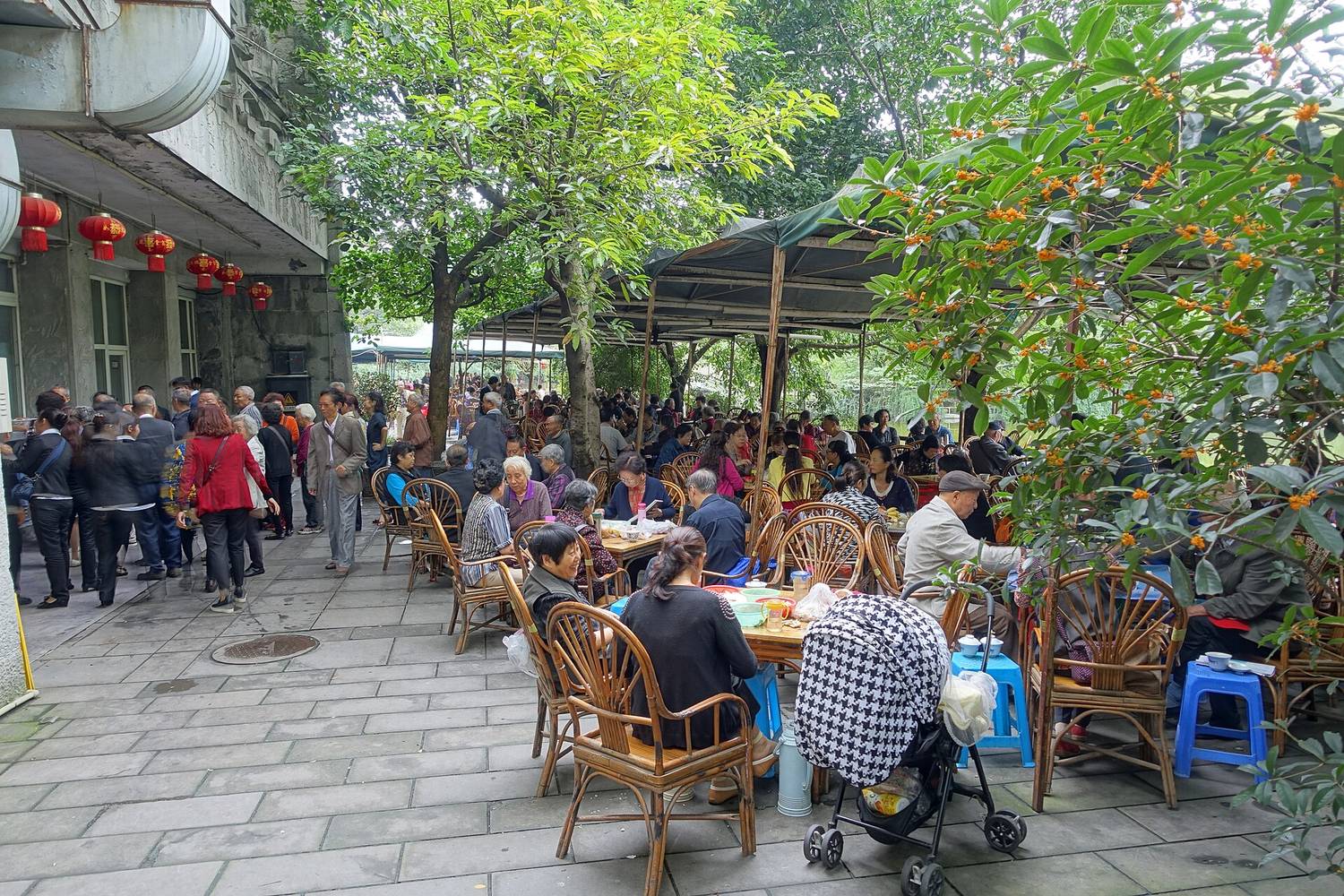
A few details make a real difference. Chinese hotels and restaurants serve hot water and tea by default, which suits most older visitors. A teahouse afternoon — Chengdu’s People’s Park is the classic — is the best low-effort half-day in the country. And we build in one “nothing day” per week, because the traveller who never gets an afternoon off is the one who sits out the last three days.
Eight days, Beijing and Xi’an — the Great Wall by cable car, the Forbidden City with a wheelchair on standby, then four and a half hours by high-speed rail to the Terracotta Army. Ten days adding Shanghai and Suzhou for gardens, water towns and the easiest city in China to walk in. Shanghai plus a Yangtze cruise, which is the most relaxed ten days we run and a favourite with grandparents travelling alongside grandchildren. Chengdu and Yunnan for teahouses, pandas at a slow pace and mild weather in almost any month.
What we avoid on these trips: four cities in ten days, overnight trains, hikes with a fixed time limit, and anything that depends on the group moving quickly through a crowd.
Ages, mobility, whether anyone uses a cane, walker or wheelchair, medical conditions, medication that must be kept cold, dietary and halal requirements, and how much walking is genuinely comfortable. Two lines on WhatsApp is usually enough. We will say plainly if a route you have in mind is a poor fit, and propose the version that is not.

Tell us your dates, who is travelling and roughly what you want to see. Within 24 hours a China-based planner sends you a day-by-day itinerary with everything itemised — free, and with nothing to pay until you approve it.
Monday–Sunday, 09:00–21:00 Beijing time (UTC+8)
Free written itinerary within 24 hours